
About SynerFuse®
SynerFuse® is a Minnesota-based medical device company innovating the spine industry with its integrated approach to spinal fusion and chronic pain. The patented SynerFuse® procedure, Electric Transforaminal Lumbar Interbody Fusion™ (e-TLIF™), combines fusion with direct nerve stimulation and is being studied to address chronic low back and leg pain that is unaddressed in traditional spinal fusion surgery, and that provides Ultra Low Energy™ (ULE™) Therapy.
Our History
While there were numerous spinal fusion product companies and several that operated in the neurostimulation market, none had the vision to combine the two therapy modalities of spinal fusion and neuromodulation into a single solution implanted simultaneously at the point of a spinal fusion procedure.
SynerFuse® was founded in 2018 with this vision. Subsequently, the company identified an enormous whitespace opportunity and built a deep and broad intellectual property portfolio around it, creating the SynerFuse® e-TLIF™ (Electronic Transforaminal Lumber Interbody Fusion™) procedure enables ULE™ (Ultra Low Energy™) Therapy solution that integrates spinal fusion and neuromodulation.
In 2022, the first SynerFuse® e-TLIF™ patented procedure was performed at the University of Minnesota, M Health Fairview. In 2025, the proof-of-concept study was completed involving 15 e-TLIF™ procedures. The company has a strong history of working with doctors in spine and pain to bring about innovative solutions to the medical industry.
The Spinal Fusion Market and Pain Management Opportunity
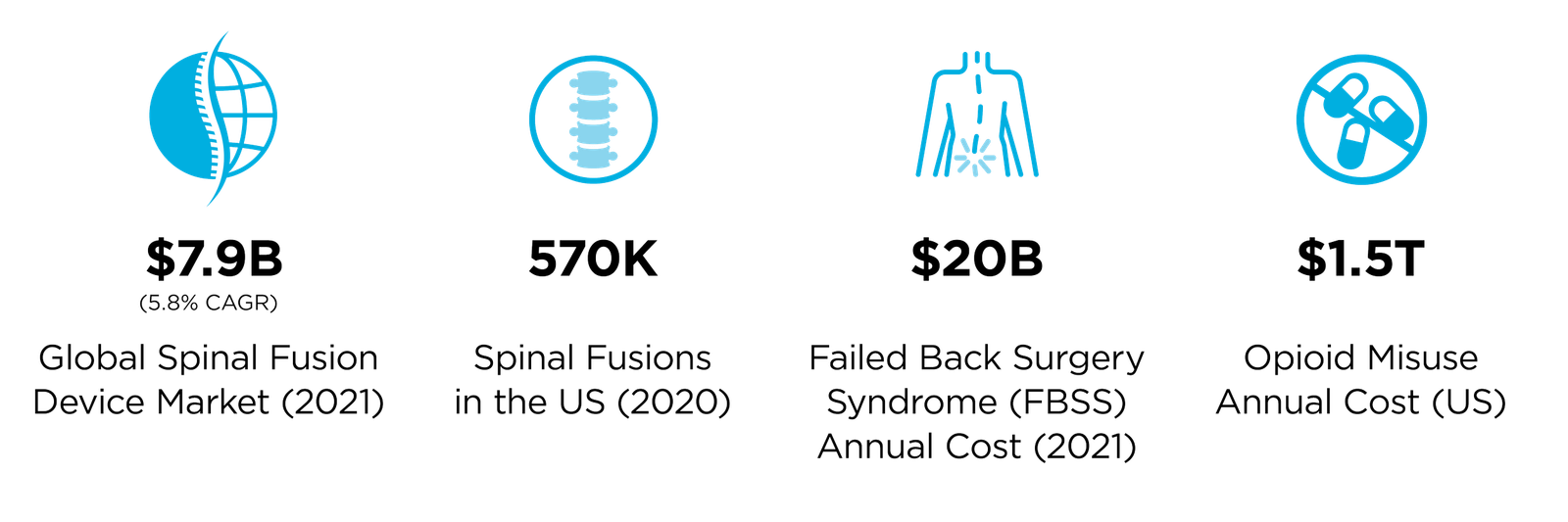
Between 2016 and 2022, US hospitals recorded 1,029,610 primary and 183,110 revision elective lumbar fusions — a revision burden of about 15% (Ng MK, et al. The Spine Journal 2026;26(9):1737–1746, National Inpatient Sample). Up to 28% of patients who meet the criteria for surgical treatment continue to have chronic low back or leg pain after a technically successful operation (Park MC, Lall RR, Reddy D, Sembrano JN, Falowski SM, Haider NR. Integrating dorsal root ganglion stimulation with transforaminal lumbar interbody fusion: proof of concept study. North American Spine Society Journal. 2026;27:100906. ).
Low back and neck pain accounted for an estimated $134.5 billion of US health care spending in 2016 — more than any of the other 153 conditions studied (Dieleman JL, et al. JAMA 2020;323(9):863–884). A common treatment pathway is a narcotic-based regimen; if that is not successful, neurostimulation is sought in a two-step process, a trial and then a final implant, so a patient may undergo three procedures. The SynerFuse® approach under study combines the fusion and the stimulation implant in one.
Figures describe the disease state and the market. They are not claims about the performance of any SynerFuse product.
SynerFuse® Indications
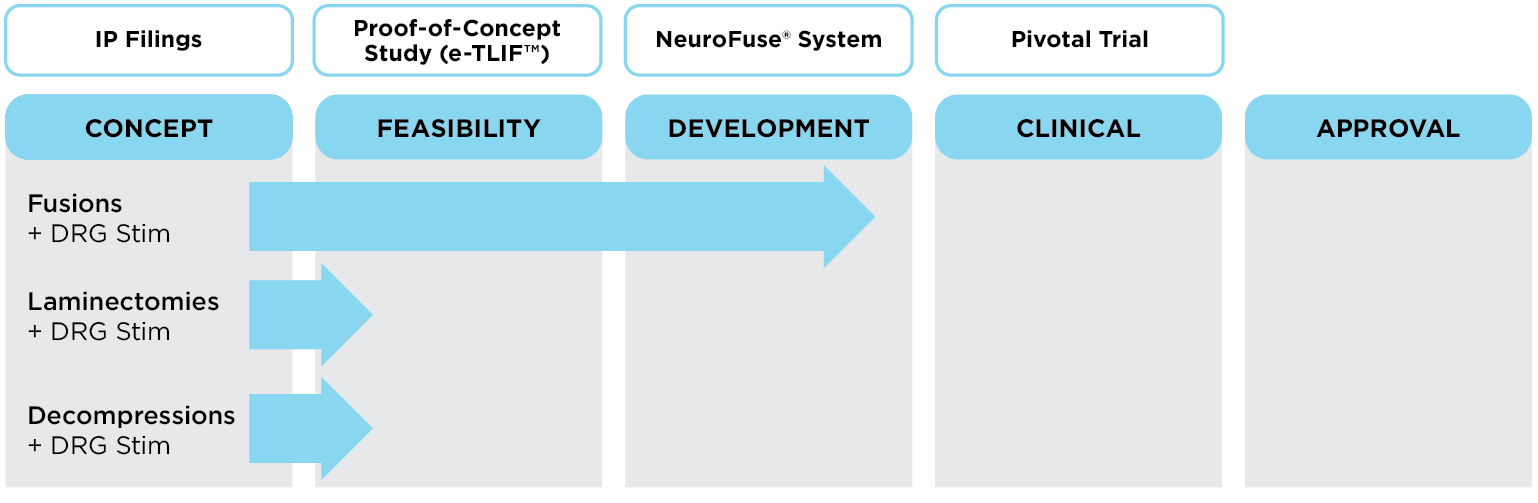
SynerFuse® completed a proof-of-concept study to evaluate the feasibility and safety of the Electric Transforaminal Lumbar Interbody Fusion (e-TLIF™) procedure, an Ultra Low Energy™ (ULE™) Therapy that integrates spinal fusion with direct nerve stimulation and is being studied for neuropathic chronic low back pain. Based on the data and learnings from that study, the company intends to finalize the design of the NeuroFuse® System and prepare for a pivotal trial, which is not yet registered. Alongside that work, SynerFuse® continues to build its intellectual property portfolio and to develop regulatory and reimbursement strategies.
The e-TLIF procedure and the NeuroFuse System are investigational. They are not cleared or approved by the FDA and are not available for sale.