

Clinical Research
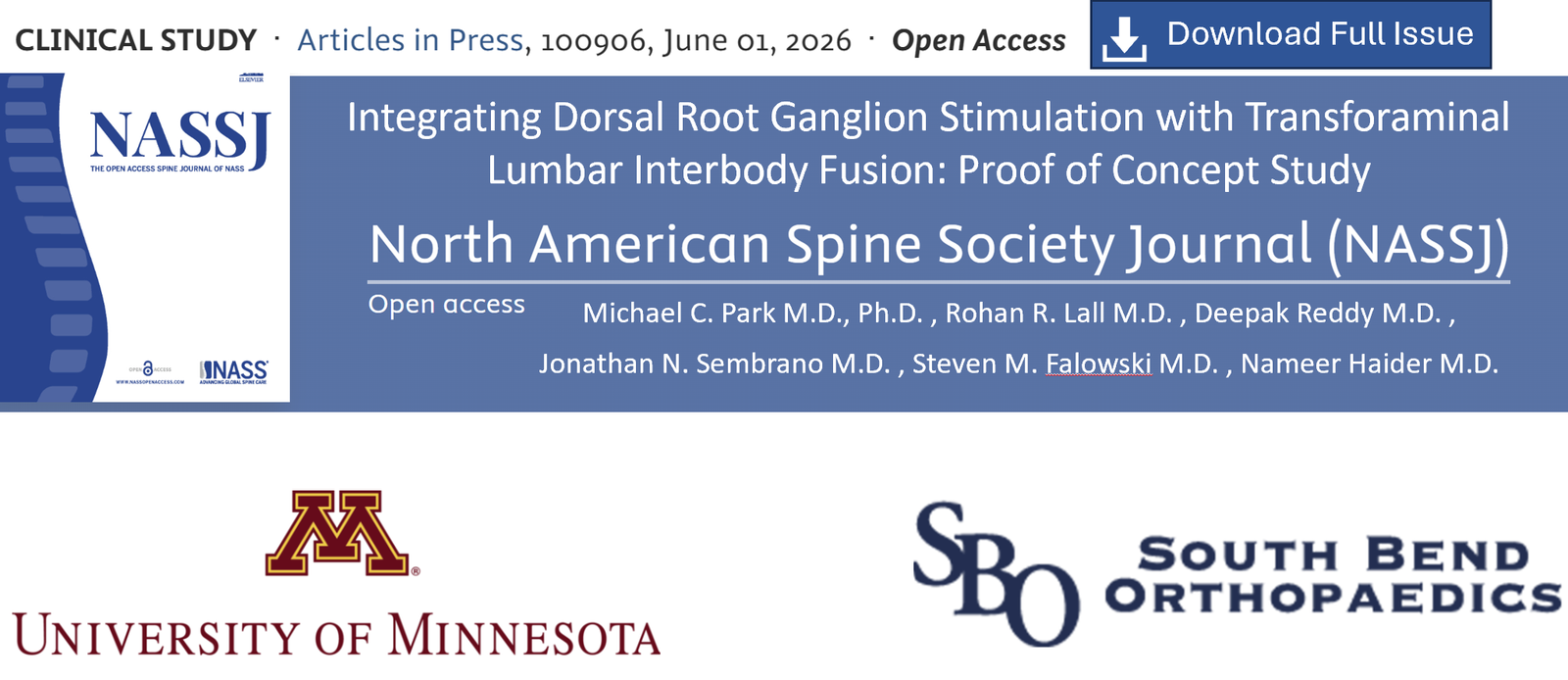
SynerFuse has completed one clinical study of the e-TLIF™ procedure: an uncontrolled, single-arm proof-of-concept series in fifteen patients. Its purpose was to establish feasibility and safety, not to establish effectiveness. The results were published, open access, in the North American Spine Society Journal in 2026. This page states what that study did, what it reported, and what it cannot show.
Investigational device. The SynerFuse® e-TLIF™ procedure and the NeuroFuse® System are investigational. They are not cleared or approved by the FDA, are not available for sale, and are limited by federal (or United States) law to investigational use. Nothing on this page is medical advice or a claim of safety or effectiveness.

Coverage
Becker’s Spine Review reports on the proof-of-concept results published in the North American Spine Society Journal. Third-party coverage of the study above; the published paper is the primary source.
Trial Sites and Partners
The proof-of-concept study was conducted at the University of Minnesota, Minneapolis, Minnesota, and at South Bend Orthopaedics, Mishawaka, Indiana (ClinicalTrials.gov NCT04054401). SynerFuse® has partnered with RQM+ for clinical trial monitoring and regulatory services, and with Velentium Medical for development and manufacturing of the NeuroFuse® System.

The study
Fifteen patients with chronic low back pain and/or lumbosacral radiculopathy, who had an indication for transforaminal lumbar interbody fusion (TLIF), received a dorsal root ganglion (DRG) stimulator placed by Direct Visual Placement during the same operation as their fusion. The study was an uncontrolled case series: there was no comparison group, no randomisation and no blinding. Endpoints were adverse events, change in back and leg pain on a visual analog scale (VAS), and opioid usage, tracked from baseline to 12 weeks, 6 months and 12 months.
ClinicalTrials.gov registration: NCT04054401, SynerFuse Spinal Fusion and Neuromodulation Proof of Concept Study. Study sites: University of Minnesota, Minneapolis, Minnesota, and South Bend Orthopaedics, Mishawaka, Indiana.
What the publication reports
- Safety. No serious adverse event was recorded, and no adverse event was attributed to combining the two procedures. One instance of electrode migration occurred without loss of therapy.
- Back pain. VAS scores improved 67%, 72% and 71% from baseline at 12 weeks, 6 months and 12 months.
- Leg pain. VAS scores improved 67%, 69% and 69% at the same time points.
- Responders (VAS reduction of at least 50%). 53.3% for back pain and 60.0% for leg pain at 10–20 days, rising to 66.7% and 73.3% at 12 months.
- Opioid use was down to 20% from 12 weeks through 12 months.
- Stimulation parameters. 20 Hz, 250 microsecond pulse width, amplitude below 1 mA.
These are the findings of a fifteen-patient uncontrolled series. They describe what happened to those fifteen patients. They are not evidence that the procedure is safe or effective, and they are not a claim that it is.
Limitations
- Fifteen patients, single arm, no control group — improvement cannot be attributed to the stimulation rather than to the fusion, to natural history, or to placebo response.
- The study was designed for feasibility and safety. It was not powered to test effectiveness.
- Every author reports a financial relationship with SynerFuse, Inc. The conflict-of-interest statement is published with the paper.
- Follow-up ran to 12 months. Longer-term durability is unknown.
- A pivotal trial has not yet been registered on ClinicalTrials.gov.
Regulatory status
The e-TLIF procedure and the NeuroFuse® System are investigational. There is no FDA clearance and no FDA approval: no 510(k), no PMA, and no Breakthrough Device designation. The clinical work has been conducted under an FDA-authorized Investigational Device Exemption (IDE). The device is not available for sale and is limited by federal (or United States) law to investigational use.
Citation
Park MC, Lall RR, Reddy D, Sembrano JN, Falowski SM, Haider NR. Integrating dorsal root ganglion stimulation with transforaminal lumbar interbody fusion: proof of concept study. North American Spine Society Journal. 2026;27:100906. Open access. Read the paper: Integrating dorsal root ganglion stimulation with transforaminal lumbar interbody fusion: proof of concept study. DOI 10.1016/j.xnsj.2026.100906 · PMID 42382825 · PMCID PMC13316635.
Medically reviewed by Rohan Lall, MD, Chief Medical Officer, SynerFuse. Last reviewed 24 August 2026.